
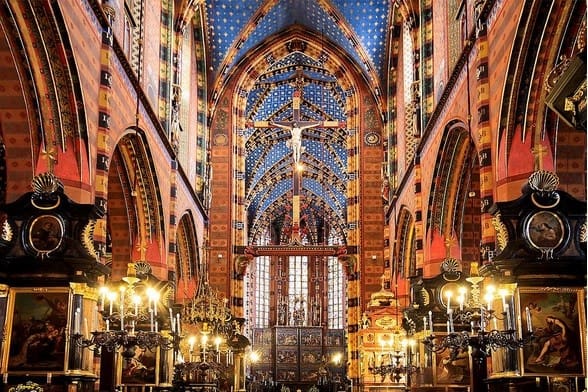
War and Post-War History of Krakow Works painted by Hans Suess von Kulmbach, by Wojciech Walanus and Agata Wolska
(For history professors and students, clergy, laity, and art historians.)
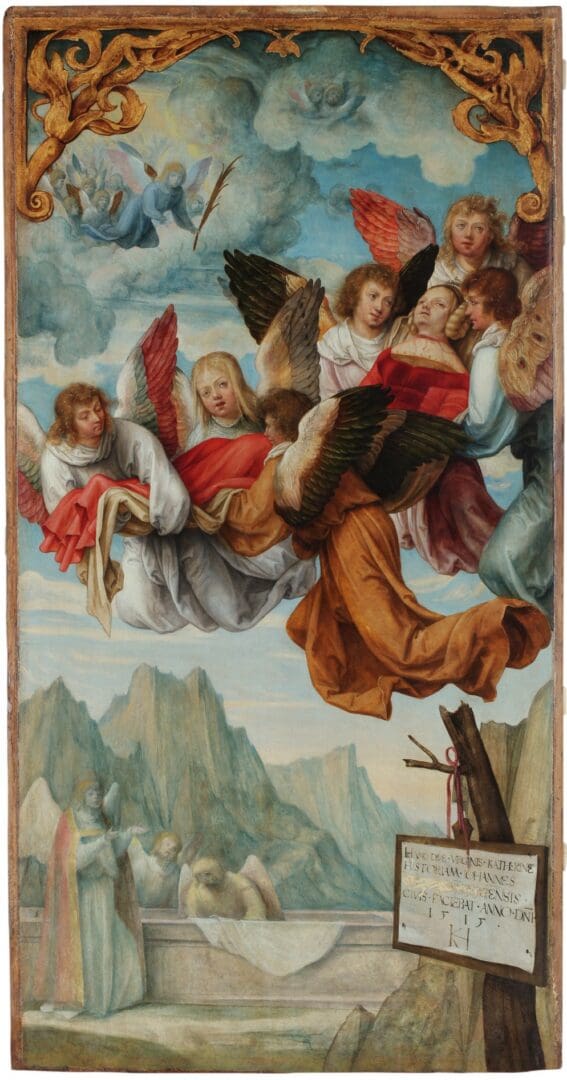
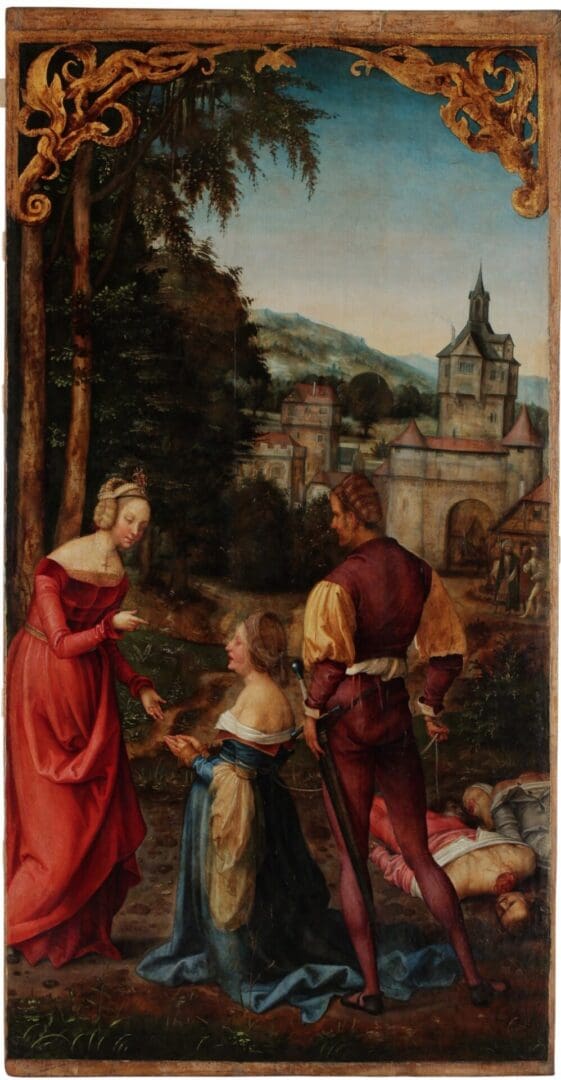
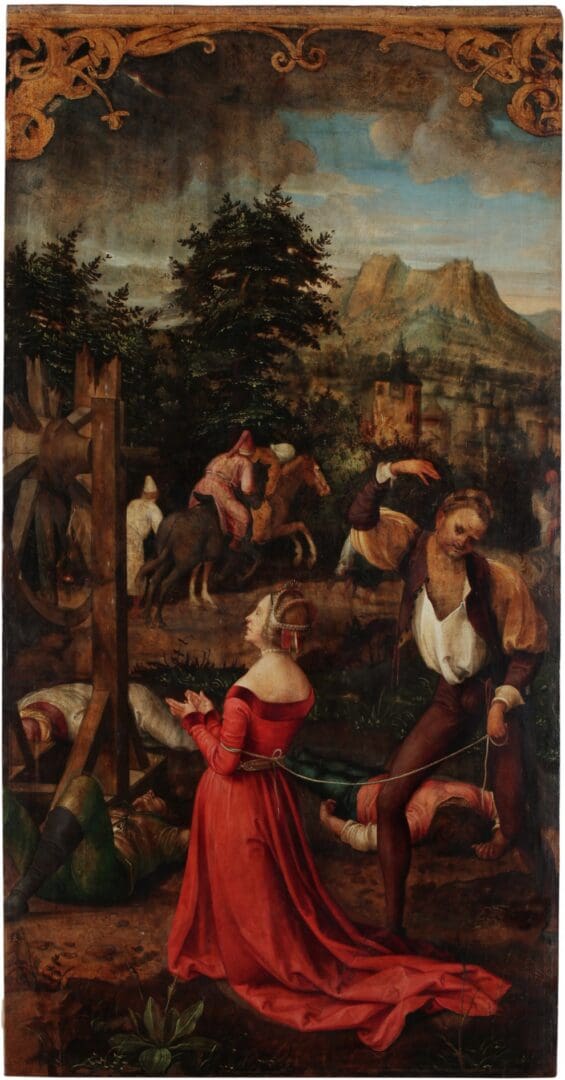
Out of 18 paintings by Hans Suess von Kulmbach belonging to Krakow’s churches, monasteries, and private collections before 1939, as many as eight are currently considered lost. The following six works are classified as undisputed war losses: two panels of the St. Catherine of Alexandria cycle from St. Mary’s Church and four panels of the St. John the Evangelist cycle from St. Florian’s Church1. Less clear is the impact of wartime events on the loss of the following two paintings from the Potocki collection: The Presentation in the Temple and St. Barbara. In this article, we will trace the fate of all of Hans Suess von Kulmbach’s Krakow works from the beginning of the German occupation of Poland, when they fell victim to organized theft, through their evacuation deep into Germany in response to the approaching Soviet forces, and up to the restitution to their rightful owners in the post-war years. The six works revindicated from Germany are shown below. They were recently restored by ASP (Jan Matejko Academy of Fine Arts in Cracow) and their restoration was funded by the Getty Foundation.
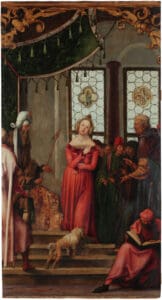
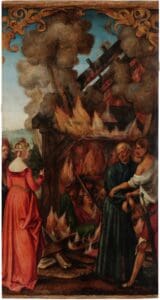
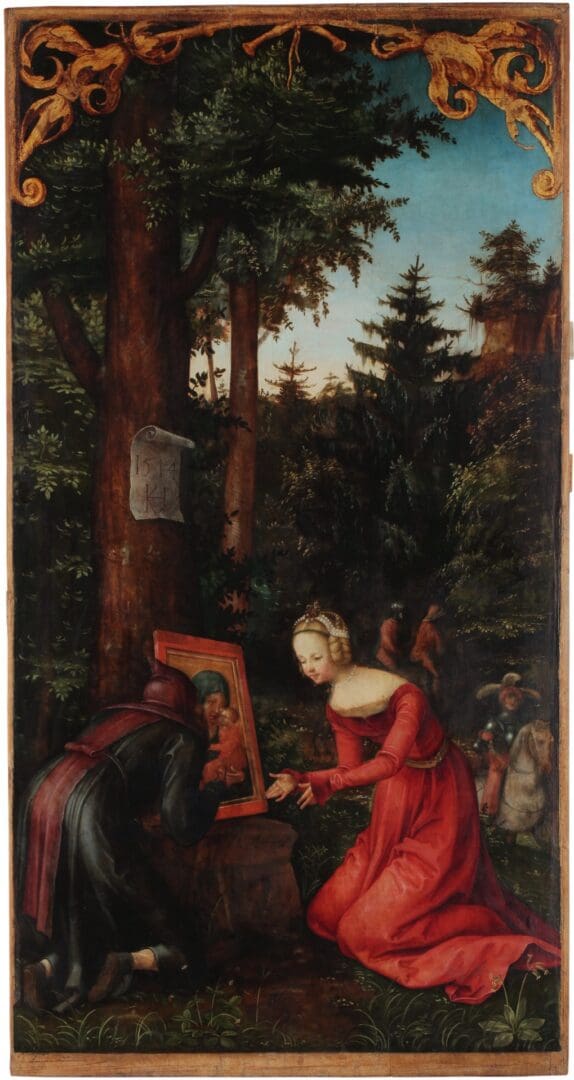
by the Hermit
of St. Katherine to Mt. Sinai
PART I
One of the most characteristic features of Nazi Germany’s policy towards the countries it occupied was the looting of works of art and cultural objects. Carried out by units specifically created for this purpose, it was to a large extent the result of the passion for valued paintings and works of art of Adolf Hitler and his acolytes (for example, Marshal Hermann Göring), as well as a biased belief in the cultural inferiority of the conquered nations. There was also the common desire for personal enrichment, especially by lower-ranking soldiers2.
In the territory called the General Government, which the Germans established in central Poland, the robbery of works of art was carried out within a specific legal framework. In October 1939, SS-Sturmbannführer Kajetan Mühlmann, an art historian by education, and former secretary of state in the Nazi government of Austria3, arrived in Krakow on the orders of Hermann Göring. He was appointed as the Special Plenipotentiary for the Inventory and Securing of Art and Cultural Treasures in the General Government. He promptly carried out the orders of Governor-General Hans Frank, who appointed him to head the Cultural Department in the newly-established General Government. After assembling a large team of specialists (art historians, historians, and conservators), Mühlmann began “securing” works of art from museums, churches, and private collections. His actions were approved by two ordinances issued by Hans Frank in 1939: “Ordinance on the confiscation of the property of the former Polish state” (November 15) and “Ordinance on the confiscation of works of art in the General Government” (December 16). The second ordinance, together with supporting regulations issued on 15 January 1940, ordered the confiscation of virtually all paintings, sculptures, and artistic craftsmanship, manuscripts, weapons, and coins created before 1850, including those belonging to private and church collections. All decisions in these matters were to be made by the Special Plenipotentiary (Mühlmann)4.
The confiscated objects were gathered in the basements of the new building of the Jagiellonian Library, where a conservation workshop was set up by Eduard Kneisel, an employee of the Kunsthistorisches Museum (Museum of Art History) in Vienna, who was brought in specifically for this purpose5. The objects were divided into three categories or “choices,” according to qualitative criteria – the first category (I. Wahl – “first choice”) included works of the highest rank, the fate of which was to be decided by Adolf Hitler himself6. A one-of-a-kind summary of Mühlmann’s activities was a luxurious catalog of first-choice works published in 1940, titled Sichergestellte Kunstwerke im Generalgouvernement (Confiscated Artworks in the General Government), a copy of which Hans Frank presented to the Führer7.
The paintings by Hans Suess von Kulmbach of Krakow, who was one of the most outstanding German painters of Albrecht Dürer’s era, were well-known to the members of Mühlmann’s team, for example from a monograph by Franz Stadler published in Vienna in 19368. “Securing” these works of art was a matter of great importance that supported the goals of Nazi propaganda. The presence of the Nuremberg master’s works in the former capital of Poland would serve as proof of German cultural domination in the East. It appears that Suess’s works from St. Mary’s Church were confiscated first. Although the panels of the St. Catherine cycle were hidden in the last days of August 1939 by Adam Bochnak in the Carmelite convent on Wesoła Street9, Bochnak himself recalled, “they were soon brought back to the church, because the Germans threatened Rev. prelate Kulinowski with repressions10.” Other contemporaneous sources also point to their removal from the interior of the basilica11. Their confiscation, together with the painting The Descent of St. John the Evangelist into the Tomb, was confirmed in writing on 5 February 1940 by Werner Kudlich12, who was one of Special Plenipotentiary Mühlmann’s team members. It should be noted that, according to Erich Meyer-Heisig, another official of Mühlmann’s office, one of the panels of the St. Catherine cycle had been sent for restoration a few years before the war, which Kudlich managed to establish “after long inquiries13.” It is possible, however, that Meyer-Heisig described one of the panels from the St. John the Evangelist cycle in St. Florian’s Church. Kudlich “secured” these panels at about the same time because their confiscation was noted in the parish chronicle on 8 February 1940, and the receipt issued by Werner Kudlich also bears this date14. Later, a 1942 audit report of the Special Plenipotentiary’s office’s activities by the chamber of the General Government noted that an inspection at the church found one painting missing. It was later established that it had been stored “at the house of the director of the state school of artistic craftsmanship” since 1925, where it was ultimately found15.
On 29 May 1940, Werner Kudlich “secured” the painting St. Catherine from the Prince Czartoryski Museum, along with the museum’s other works, and placed them in the Special Plenipotentiary’s warehouses. The receipt he issued bears a date of 31 May 194016.
The last object robbed was the panel depicting The Flight into Egypt, owned by the Pauline monastery at Skałka. As Janusz Zbudniewek ascertained, the Pauline fathers, upon hearing of the Special Plenipotentiary’s activities, hid the work with their colleagues at the Jasna Góra monastery17, but the Germans managed to find it there. The confiscation document was signed at the monastery on 27 August 194018.
However, Mühlmann’s team failed to capture the two paintings belonging to Adam Potocki that were kept in the Palace pod Baranami before the Second World War. These were The Presentation in the Temple and St. Barbara. Although they were noted in the catalog Sichergestellte Kunstwerke im Generalgouvernement (albeit with the owner’s first name listed incorrectly19), as well as in the previously mentioned audit of the Special Plenipotentiary’s office20, no cards confirming their “securing” were issued, and a verification of the office’s holdings carried out in 1943–1944 showed that both paintings had been missing from the beginning and were entered into the catalog by mistake21. What happened to them remains a mystery. At the beginning of the German occupation, the Palace pod Baranami was seized as the seat of the Krakow district governor, Otto von Wächter, who was at times suspected of stealing valuable paintings22, but it cannot be ruled out that they went missing in other circumstances. Therefore, it is likely they were entered into the catalog Sichergestellte Kunstwerke im Generalgouvernement not so much by mistake, but “in anticipation,” in the hope that it would be possible to acquire them in the future23.
Mühlmann’s team also “secured” a few works indirectly associated with Hans Suess von Kulmbach. This was the painting The Adoration of the Magi from the Diocesan Museum in Sandomierz (confiscation receipt dated 6 June 194024), and the sculptures of the altarpiece of St. John the Baptist and St. John the Evangelist from St. Florian’s Church taken in August 194025 .
As noted above, works assessed as the ‘first choice’ were reserved for the personal use of Adolf Hitler. At the end of November 1939, Hans Posse, Hitler’s special plenipotentiary, who was gathering exhibits on his behalf for the future Führer Museum in Linz, Austria, arrived in Krakow to review the artworks confiscated in Poland. In his report, he listed several paintings that he believed would be worth acquiring for German art collections, including the panels by Hans Suess von Kulmbach from St. Mary’s Church in Krakow26. However, in contrast to Leonardo’s Lady with an Ermine or Raphael’s Portrait of a Young Man, previously brought to Berlin in 1939 (albeit briefly), the paintings of the St. Catherine cycle and the other works of the Nuremberg painter remained in Krakow until the summer of 1944.
An important responsibility of Mühlmann’s office – both from a practical and propaganda standpoint – was the conservation care given to the looted works of art. The introduction section of the Sichergestellte Kunstwerke im Generalgouvernement catalog emphasized the Special Plenipotentiary’s efforts to save the “secured” objects, which purportedly were in very poor condition due to years of alleged neglect27. Restoration efforts included the Krakow paintings of Hans Suess von Kulmbach. It has been established that at the turn of March and April 1940, Eduard Kneisel renovated the panels of the St. Catherine cycle and likely also the paintings of the life of St. John the Evangelist28. The scope of these renovations is unknown, but it can be assumed that they consisted mainly of cleaning, removing overpainting, and varnishing29. The Flight into Egypt from Skałka was also subjected to conservation, although this probably happened two years later. In 1942, this painting was exhibited at the Altdeutsche Kunst aus Krakau und aus dem Karpathenland (Old German Art from Kraków and the Carpathian Region) exhibition, organized in Krakow by the Art History Section of the Institute for German Eastern Work (Institut für Deutsche Ostarbeit)30. As noted in the catalog, the panel was “temporarily” restored31. Mühlmann’s team was also required to prepare photographic documentation of the “secured” works, mainly for publishing the catalog Sichergestellte Kunstwerke im Generalgouvernement and conducting conservation work32. It has been established that photographs of the St. Catherine cycle panels and the painting The Flight into Egypt from Skałka were taken by Stanisław Kolowca, whose photographs were published in several German publications during the German occupation of Poland33.
In July 1942, Hans Frank’s renamed the Special Plenipotentiary’s office as the Office for the Care of Ancient Art (Amt für die Pflege alter Kunst), which was still directed by Mühlmann34. Frank, however, intended to take full control of the works of art looted in the territory of his “state” and, in the spring of 1943, he ordered the transfer of all first- and second-choice works from the basements of the Jagiellonian Library to the underground of Wawel Castle. He entrusted this task to his artistic advisor, Wilhelm Ernst Palézieux, who was also to conduct an inventory of the collections and establish the fate of missing objects35. Between April 12 and June 17, 1943, the works were transported to Wawel and placed in its basement36. After Palézieux revealed numerous irregularities, Mühlmann, under pressure from Frank, submitted his resignation effective 1 October 1943. The Office for the Care of Ancient Art was liquidated and its responsibilities were transferred to the Board of Museums at the Main Department of Science and Education of the General Government37. From that point on, the actual care over the confiscated works of art – including the paintings by Hans Suess von Kulmbach – was done by Palézieux, who was appointed as referent for art and architecture in the Governor General’s Chancellery38.
In the summer of 1944, faced with the rapid advance of the Red Army, the authorities of the General Government began hasty preparations to evacuate and transfer their “secured” property to Lower Silesia. For Hans Frank’s temporary headquarters, Palézieux chose Manfred von Richthofen’s palace in Sichów (Seichau) in Jawor County. As directed by Frank, the works of art at Wawel were also to be taken there. Most of them ended up in Sichów in August 1944 and, over the next few months, Palézieux and Eduard Kneisel, who were to look after them, inventoried and compiled lists of the evacuated objects39. Their documentation indicates that all of Hans Suess von Kulmbach’s paintings confiscated by the Germans reached Silesia. Evidence of this is a copy of the list of first-choice works where, next to individual objects, the annotation “Seichau” was marked with a red crayon, indicating their location, or the letters “Kr” in pencil, indicating that a given work had been left in Krakow40. The note “Seichau” appeared next to the paintings The Flight into Egypt and St. Catherine41, and the panels of the St. Catherine cycle42. The sculptures of the St. John the Baptist and St. John the Evangelist altarpiece were marked in the same way, while five panels of the St. John the Evangelist cycle (four panels from St. Florian’s Church and the predella from St. Mary’s Church) were indexed with a red “check mark”, probably denoting a repetition sign43.
On 17 January 1945, Hans Frank and his closest associates left Krakow and arrived in Sichów the following day. Because Manfred von Richthofen’s palace was already filled with works of art, it was unable to accommodate the Governor General’s Chancellery. On January 20, most of the objects were transported to the residence of the Counts von Wietersheim-Kramsta in Morawa (Muhrau). On 23 January 1945, Frank left for Bavaria and entrusted the collections in Morawa to the local authorities44. Six days later, the Lower Silesian provincial conservator, Günther Grundmann, arrived in Morawa and prepared the evacuation of the most valuable cultural property from the repositories that remained under his care. On 30 January, with the help of a Wehrmacht unit stationed on the estate, he managed to pack some of the paintings and transport them in two trucks to the library of the Schaffgotsch palace in Cieplice (Warmbrunn). As the Soviets rapidly advanced, Grundmann decided to transport selected works deep into Germany and, loading them this time onto only one truck, he set off for Coburg in Bavaria and arrived there on 1 March. These works, including the paintings by Hans Suess von Kulmbach from Polish collections, saw the end of the war45 in the garage of the Callenberg Castle located near Coburg.
In testimony given to American investigators, Grundmann said that, among the works gathered in Morawa, he recognized the “St. Catherine altar from Krakow.” This is because he took the works he considered most important to Cieplice, including the “altar of Süss from Kulmbach46.” Other sources confirm that six of the eight paintings of the St. Catherine cycle were brought to Coburg, as were the paintings St. Catherine, taken from the Prince Czartoryski Museum, and The Flight into Egypt from Skałka47. What happened to the panels depicting The Conversion of Empress Faustina and The Beheading of St. Catherine? In a post-war account, Grundmann stated that it was not possible to load all the items gathered in Cieplice onto one truck, consequently, many of them had to remain in the Schaffgotsch palace. He thought that the “missing parts of the altar of Süss from Kulmbach” were certainly among them48. It is difficult today to assess the reliability of this last known source on the location of both of these paintings. Even less is known about the fate of the four panels with scenes from the life of St. John the Evangelist. Grundmann did not mention them49, so it is difficult even to speculate whether he saw them in Morawa, and if so, whether he took them from there to Cieplice. It should be noted that the predella with The Descent of St. John into the Tomb was not taken to Bavaria. Fortunately, it was found after the war in Silesia by one of the Polish recovery groups. The question of whether the paintings by Hans Suess von Kulmbach, left in one of the Silesian repositories, fell victim to robbers once again in 1945, or whether – which unfortunately cannot be ruled out – they were destroyed as a result of hostilities or vandalism, is impossible to answer with the current state of knowledge.
PART II
The end of hostilities meant that the administrations of the victorious armies – the Americans in Bavaria and the Soviets in Lower Silesia – took control of German resources, including repositories containing cultural objects50.
Securing works of art found in the American-occupied territory of Germany was the task of specialized personnel of the Fine Arts Monuments and Archives section (hereafter: MFA&A) in the G-5 Civil Affairs branch of each army of the Allied forces. On 11 April 1945, after a one-day skirmish, Coburg was taken by the US 3rd Army, where Captain Robert K. Posey51 served as an MFA&A officer in the frontline zone. His responsibilities included checking the condition of monuments and finding repositories of works of art. Due to the rapid advance of the Allied troops, he was unable to reach every town immediately, much less conduct thorough reviews of the discovered warehouses52. Often, however, the current German curators themselves submitted reports on the collections remaining in their care. Faced with a dramatic shortage of trained personnel, Posey frequently decided to leave the Germans in their positions, even though he was fully aware of their Nazi past53. On 30 April 1945, after Günther Grundmann told the Military Government about the Polish monuments evacuated from Lower Silesia54 that were under his exclusive supervision, he was entrusted with their care and, in accordance with accepted practice, with their inventory55. He compiled a list of the paintings and tapestries of the “government of the General Government in Krakow,” and packed them in nine crates marked with the symbol “GG” with consecutive numbers from one to nine56. On 13 May 1945, responsibility for the works was assumed by Lieutenant Howard from the Military Government of Coburg57. At the end of the month on 30 May 1945, for practical reasons, a decision was made to consolidate the works previously located in Callenberg Castle and objects from the repository in Rosenau Castle into a temporary collection set up in a wing of the nearby Tambach Castle, belonging to the Ortenburg family58, where the Military Government of Coburg (Det. I2B3) provided them with constant supervision59. On 24 July 1945, the head of the Military Government, Major Harry Lockland, appealed to the local MFA&A unit based in Ansbach to mark the entire castle with “off limits” signs and exempt it as a monument of special importance from military billeting. At the same time, he reported that he had indisputably recognized Polish property in the collection brought from Coburg. These included the paintings from Wawel, which he remembered from pre-war visits to Poland, and Günther Grundmann had further confirmed their origin60. The news about the Polish monuments reached the Polish Administrative Team that managed the Polish Camp in Coburg. On 29 July 1945, its commandant, Major J. Podhorski of the Polish Armed Forces, sent a request for the Americans to care for them until their return to the rightful owners61. At the current stage of research, it is difficult to determine whether Podhorski had access to the objects and whether he was allowed to catalog them. Reports from other sources suggest that MFA&A officers tried, as a matter of principle, to make the collections under their care available for viewing by American military personnel62. Interested parties could also view Polish paintings stored in Tambach Castle63.
The political situation in the summer of 1945 excluded the Government of the Republic of Poland in Exile from restitution activities, while the lack of a clear international policy made it impossible to take concrete steps towards returning looted cultural property to its owners. Only in the autumn did the Americans adopt a program of unilateral ad interim (in the meantime) restitution in which unambiguously identifiable objects were to be returned to the country of origin. For this purpose, central collection points were established in which the monuments were registered, photographed, and stored. Representatives of the claimant states had free access to the warehouses, where they identified their property. After positive verification, an inventory consisting of Property Cards was compiled and travel documents were prepared accompanied by a list with identification numbers and the names of presumed owners. This was followed by a second review to check for errors and possible conservation interventions, which was done only when the condition of the monuments precluded immediate transport. Finally, the objects were packed under the supervision of national experts64.
Although the decision had been made at the end of August65 to send the six panels by Hans Suess von Kulmbach from the St. Catherine cycle and the paintings The Flight into Egypt and St. Catherine along with other Polish works from Tambach Castle to the Munich Central Collecting Point (MCCP) as quickly as possible, it was only done on 13 December 1945. It happened after the first visit paid by Dr. Karol Estreicher66, who was delegated by Leon Kruczkowski, the Deputy Minister of Culture of the Provisional Government of National Unity, to go to Germany and Austria to find Polish works of art67. He made his first visit to the Munich collection point on 16 November 1945 and his main task was to arrange for the return of the Veit Stoss altar from Nuremberg. For various regulatory reasons, the Americans suggested postponing its return and recommended waiting for a “drier season.”68 Although Estreicher had already been authorized by the Warsaw authorities on 5 February 1946 to collect works of Polish origin69, the Polish side agreed to delay the transport date. Władysław Tomkiewicz, head of the Bureau for Recovery and Damages of the Ministry of Culture and Art, instructed Estreicher on 26 February 1946: “[…] please use your legal authorization and take other things as well, i.e., the paintings by Canaletto, Kulmbach, the Kmita chasuble, etc.,70 mentioned by you.” As a result, by 17 April 1946, all recovered Polish objects authoritatively identified by Karol Estreicher were gathered at the MCCP, including those previously stored in the Marburg Central Collecting Point and the Wiesbaden Central Collecting Point71. After concluding the restitution formalities72 and signing the documents that transferred responsibility for the returned monuments to the Polish government73, a train consisting of 28 railcars was assembled. Escorted by American guards, it departed Nuremberg on 28 April 1946 and arrived in Krakow two days later74. The restitution train was unloaded on 2 May 1946, and, following the established protocol, the crates containing the monuments were taken over by the Directorate of State Art Collections at Wawel75. On Wawel Hill, a central repository was established by the Ministry of Culture and Art, where recovered items were methodically brought, mainly from the territory of Lower Silesia. A conservation workshop run by Marian Słonecki was also set up there76. On 22 June1946, Tadeusz Mańkowski, the director of the State Art Collections, sent a letter to the General Directorate of Museums and Monument Protection with a request for permission to release the “objects brought by Dr. Karol Estreicher to their owners.” This included the six panels of the St. Catherine cycle to St. Mary’s Church and the painting The Flight into Egypt by Hans Suess von Kulmbach77 to the Pauline monastery at Skałka. Consent for the return was granted on 1 August 1946 and contained no additional conditions78. The final takeover of the monuments by the board of St. Mary’s Church took place a month later on 7 September 194679.
The Pauline fathers did not receive formal notification that The Flight into Egypt had survived and was brought to Poland80. Around 11 June 1946, the monastery received news of the arrest of Mühlmann by the American authorities. Mühlmann was responsible for looting works of art in Poland, including the monastery’s collections81. Wanting to gauge the chances of extracting information about the fate of their monuments from the arrested man, the Paulines sought the opinion “of various personalities in Krakow who have contact with these matters.” The “personalities” suggested direct intervention by the United States embassy. Along the way, the monks learned that the painting from Skałka was probably already at Wawel82. Anticipating difficulties in recovering Hans Suess’s work, Prior Father Leonard Ligęza sent a letter to the American embassy on 12 July 1946, addressed to the military attaché, Walter Pashley, asking for Joseph Mühlmann (Kajetan’s brother) to be questioned in order to find the looted monuments and return them to the monastery83. The letter had the personal support of Archbishop Adam Sapieha, and the enclosed catalog of the exhibition Altdeutsche Kunst aus Krakau und aus dem Karpathenland was meant to help identify the objects84. It is notable that the letter was addressed to the only American Embassy representative who was present at the arrival of the restitution transport from Bavaria. The Paulines’ anonymous advisor must have been exceptionally well acquainted with the details of this restitution. The Americans took the matter very seriously, ordering searches for all the exhibits85 listed in the catalog, and concluded that three exhibits, including the painting by Hans Suess von Kulmbach, had already been sent to Poland86. Before the final answer from the American side reached Skałka, The Flight into Egypt was handed over to the monastery authorities87 and the prior immediately notified the United States Ambassador Arthur Bliss Lane88. If correspondence with the American Embassy was meant to pressure the return of the work, it worked superbly.
The painting St. Catherine from the Czartoryski collection, after being brought to Krakow, was initially incorrectly identified as the painting St. Barbara that belonged to the Potocki family. As a result, it was not handed over along with the other recovered items to the National Museum in Krakow89. Instead, it remained at Wawel and was returned on 15 February 194790.
The circumstances under which another work by Hans Suess von Kulmbach, the predella with the scene of the last mass of St. John the Evangelist, which was found in Lower Silesia, have not yet been unambiguously established91. In 1947, it was identified for the first time in the manuscript draft of the catalog of the Medieval Art Gallery of the National Museum in Warsaw92. Perhaps the predella was originally brought to the Wawel repository or it went directly to the capital from Lower Silesia. The information that it was found in the Warsaw museum was not widely known. The General Director of Museums and Monument Protection, Władysław Tomkiewicz, had erroneous information about the storage of the predella at Wawel. At the time, he had been preparing a catalog of losses of foreign paintings for print in 1949 and used the aforementioned publication Sichergestellte Kunstwerke im Generalgouvernement93 as a starting point. He did not have “reliable data” on three of the group of paintings from the Krakow collections, including two by Hans Suess von Kulmbach. The aforementioned predella and St. Barbara were identified as the property of Franciszek Potocki (repeated after Sichergestellte Kunstwerke im Generalgouvernement)94. Replying to Tomkiewicz’s question, Adam Bochnak wrote back that none of them had returned to Krakow, and “about Kulmbach’s painting The Descent of St. John into the Tomb (from St. Mary’s Church) there were rumors, two or three years ago, that it was in the National Museum in Warsaw. However, I was unable to verify the truth of these rumors.”95 Soon Tomkiewicz confirmed that the predella was indeed in Warsaw96. Ultimately, it was incorporated into the Foreign Painting Gallery97. Political conditions in the country, progressing Stalinization, persecution of the Church, and nationalization of private collections made the restitution of the painting to St. Mary’s Church impossible. When, during the Communist thaw of 1957, the Veit Stoss altar, previously exhibited at Wawel, was returned to St. Mary’s Basilica, there was hope of recovering Hans Suess’s work. However, it was only an isolated gesture that did not signify a change in the Communist state’s policy towards appropriated church property98. Both the postulate of the Association of Art Historians, submitted during the Cultural Forum in 195699, and the attempt made by Father Ferdynand Machay, the archpriest of St. Mary’s, to recover Suess’s painting along with the Wit Stosz (Veit Stoss) altar, came to nothing100. The issue of the predella was raised again in 1967 when Jan Białostocki requested the loan of one of Giambattista Pittoni’s altar paintings from St. Mary’s Church for an exhibition of Venetian painting prepared by the National Museum in Warsaw101. Asked to mediate in this matter, Adam Bochnak did not hide the fact that a positive response from the church was conditioned on the return of the predella. This is because the Board of St. Mary’s temple held “a deep grudge against the Museum Directorate and is afraid to lend it anything […] lest the borrowed items meet the fate of Kulmbach’s painting.”102 Białostocki conveyed this position to the museum director Stanisław Lorentz103. His intervention must have failed, as a renewed chance for the restitution of the predella did not materialize until 1980, when, after the signing of the August Agreements, the authorities took steps to normalize relations between the Church and the Communist state104. On 20–21 November 1980, the work of the Joint Commission of Government and Episcopate representatives was resumed, and bishop curias and individual parishes began to apply for the return of sacred monuments exhibited in state museums. Also, at the end of December 1980, Cardinal Franciszek Macharski sent a letter on behalf of the Archdiocese of Krakow to the director of the National Museum in Warsaw, Stanisław Lorentz, with a request to return Hans Suess von Kulmbach’s painting “constituting the property of St. Mary’s Basilica in Krakow.”105 At the beginning of December, the Minister of Culture and Art – “in view of opinions and demands for integrating historical interior decorations, dispersed during the war, into buildings of worship and harmonizing newly designed decorations in those interiors with them” – established a “Team for Religious Art Displays,” which included representatives of the clergy and museum circles106. In view of this, Lorentz informed Cardinal Macharski that the matter of Hans Suess von Kulmbach’s predella was referred to this body for consideration, which was to make “general decisions” concerning possible returns of works previously owned by the Church that were located in museum galleries107. The matter of Suess’s paintings was discussed at the first working meeting of the team on 10 March 1981, since it was decided as a matter of principle that all returns, even those not raising any doubts, would first be approved by this Team. Lorentz confirmed the intent to hand over the painting to St. Mary’s Church108, and two days later the Minister of Culture and Art gave his consent to strike it from the museum inventory and give it to the parish109. The vicar, Canon Jan Wais, and an expert, Krakow art historian Michał Rożek, who played a similar role in the return of a chalice to the Wawel cathedral110, traveled to Warsaw to collect the work. The handover protocol was signed in the Museum on 19 May 1981, and the painting was taken to Krakow, directly to St. Mary’s Church111.
To date, this was the last case of the return of work by Hans Suess von Kulmbach to the Krakow collections. As indicated in the introduction, the panels from the altar of St. John the Baptist and St. John the Evangelist from St. Florian’s Church [cat. 79], two panels of the St. Catherine of Alexandria cycle from St. Mary’s Church [ills. 5–6], and the paintings from the Potocki collection: The Presentation in the Temple and St. Barbara (see ills. 1–2) still appear on the list of war losses. The principles of the Washington Conference of 1998112 adopted by the international community, the intensification of provenance research, and the digitization of museum inventories raise the hope that if these works survived the conflagration of war, perhaps one day they will return to Krakow.
FOOTNOTES
- Tomkiewicz 1949, cat. nos. 168–174, pp. 72–74; Romanowska‑Zadrożna, Zadrożny (eds.) 2000b, cat. nos. 120–125, pp. 212– In Władysław Tomkiewicz’s catalogue, the painting Saint Catherine from the collection of the Czartoryski Princes Museum was mistakenly recorded as a war loss (Tomkiewicz 1949, cat. no. 175, p. 74). Information about the lost paintings by Hans Suess von Kulmbach is also provided on the websites of the Department of Wartime Losses of the Ministry of Culture and National Heritage (http://dzielautracone.gov.pl/katalog-strat-wojennych/wyszukiwanie‑zaawansowane?s=Kulmbach [accessed: 8 December 2017]) and of St. Mary’s Basilica (http://mariacki.com/straty‑wojenne [accessed: 8 December 2017]).
- The foundational study is: Nicholas, 1997; on Hitler’s decisive role, see most recently, Schwarz, 2014.
- On him, primarily, see Petropoulos, 2000, pp. 170–204; Zadrożny, 2010.
- Zadrożny, 2000, pp. 26–28; Majewski, 2005, pp. 93–94; Łuczak, 2009, pp. 17–18.
- Zadrożny, 2011, pp. 42–43; see also Blewett, 2008, pp. 400–403.
- Zadrożny, 2000, p. 28; Majewski, 2005, p. 191; Łuczak, 2009, p. 19.
- Zadrożny, 2011, p. 45.
- Stadler, 1936.
- Kopera, Buczkowski, 1949–1957, p. 144. The receipt issued for reimbursement of the transport costs of the paintings to Adam Bochnak, dated 31 August 1939, has been preserved; Archives of St Mary’s Basilica (hereafter ABM), vol. CXXXVI, unpaginated.
- Adam Bochnak’s remembrance of Cardinal Adam Sapieha, 1966, Archives of the Metropolitan Curia in Kraków (hereafter AKMKr), Accounts related to Rev. Metropolitan Adam Sapieha, vol. 4, fol. 8, typescript.
- Kubalski 2010, p. 54; Figlewicz 2014, p. 96. In one of the reports from Poland for the Government of the Republic of Poland in exile, it was even stated that “During the mass, paintings by Hans S. Kulmbach depicting scenes from the life of St Catherine of Alexandria were taken away from the Church of Our Lady.” Archives of New Records (hereafter AAN), ref. no. 213603/206, Ministry for Congress Affairs. Cultural losses in Poland under German occupation. Extracts from domestic reports. Part II, 1940, p. 48.
- The original is in the Estreicher Family Archive; reproduction in Witek, 2003, p. 56. The date 5 February is also given by Rev. Kazimierz Figlewicz, Figlewicz 2014, p. 96.
- Meyer-Heisig, “Bericht über den Sonderauftrag zur Sicherung der Kunst- und Kulturgüter im ehemaligen Generalgouvernement”, typescript in the Estreicher Family Archive, fol. 2v; reproduction in Witek, 2003, p. 515.
- Parish chronicle 1903–1959, Archives of the Parish of St Florian in Kraków, ref. no. 101, p. 45: “On February 8th, there were seized four paintings by Hans Suess Kulmbach, from the cycle of St John the Evangelist, painted on long, narrow boards measuring 230 × 0.70 m, namely: The Martyrdom of St John – St John in the cauldron of oil, The Miracle of St John – The Poisoned Chalice, St John on the island of Patmos, and The Last Supper.” The confirmation of confiscation is in the Estreicher Family Archive, reproduction in Witek, 2003, p. 54.
- “Bericht über die Überprüfung der Gesamttätigkeit des Sonderbeauftragten für die Erfassung und Sicherung der Kunst- und Kulturschätze im Generalgouvernement”, 1942, Institute of National Remembrance (hereafter IPN), ref. no. GK 196/295, p. 16: “In the Church of St Florian there were originally four wings of the former St John altar by Hans Suss [sic] von Kulmbach. During the inspection it was established that only three wings were present in their original location. Inquiries about the fourth wing showed that it had been kept by the director of the state school of arts and crafts for restoration since 1925. It was subsequently found there.” This would suggest that the painting was deposited before the war at the Academy of Fine Arts, which functioned as the Staatliche Kunstgewerbeschule during the German occupation, for conservation work.
- As noted by Pelagia Potocka, who managed the Czartoryski Museum on behalf of the owners, on 29 May 1940 Werner Kudlich seized 42 objects from that institution’s collections (P. Potocka, “Dziennik wydarzeń w Muzeum X.X. Czartoryskich”) [Diary of events at the Czartoryski Museum]); Its copy in the archive of the Czartoryski Princes Foundation, pp. 53–54. Similar account is included in “Sprawozdanie z czynności w Muzeum X.X. Czartoryskich w Krakowie z II kwartału od 1-go kwietnia do 30-go czerwca 1940 r.” [Report on activities in the Czartoryski Museum in Kraków for the second quarter from 1 April to 30 June 1940], Czartoryski Library, ref. no. 12624, vol. 1, unpaginated, typescript. The date 31 May 1940 appears on the confiscation receipt signed by Werner Kudlich; the original is in the Estreicher Family Archive, reproduction in Witek, 2003, p. 65; a duplicate (Zweitschrift) in the Czartoryski Library, ref. no. 12624, vol. 2, fol. 2, typescript. The same day, 31 May 1940, is given as the date of requisition in “Braki wojenne w Muzeum X.X. Czartoryskich w Krakowie 1939–1941 r. i 1942 r.” [War losses in the Czartoryski Museum in Kraków 1939–1941 and 1942], Czartoryski Library, ref. no. 12624, vol. 1, unpaginated, typescript. Another copy is in the Estreicher Family Archive, reproduction in Witek, 2003, p. 401.
- Zbudniewek 1991, pp. 91–92.
- The original is in the Estreicher Family Archive, reproduction in Witek, 2003, p. 45. It includes a handwritten note by Erich Meyer-Heisig, dated 11 September 1940, stating that the painting was transferred to Jasna Góra as a collateral for a loan: “Originally kept in the church at Skałka in Kraków, the painting had been pledged to the mother-house of the order in Częstochowa as collateral for a loan.” The duplicate without the handwritten note is kept in the Archive of the Pauline Monastery at Jasna Góra, ref. no. 2674, p. 147; transcript in Zbudniewek, 1991, p. 268. According to Janusz Zbudniewek, the painting fell into German hands on 12 October 1940. Zbudniewek, 1991, p. 92.
- Sichergestellte Kunstwerke… 1940, cat. nos. 22b, 22d: “From the collection of Count F. Potocki, Krakau.” Notably, no photographs of these paintings were included in the catalogue.
- “Bericht über die Überprüfung der Gesamttätigkeit des Sonderbeauftragten für die Erfassung und Sicherung der Kunst- und Kulturschätze im Generalgouvernement”, 1942, Institute of National Remembrance (IPN), ref. no. GK 196/295, fols. 64–65.
- See the list of missing first-choice works compiled when transferring the holdings gathered by the Special Plenipotentiary to the administration of the Chancellery of the General Governor, arranged according to the catalogue numbers of Sichergestellte Kunstwerke im Generalgouvernement, in 1943 or 1944, Estreicher Family Archive, reproduction in Witek, 2003, p. 595. The paintings are listed under incorrect catalogue numbers of 22c and 22e, with the note: “Nos. 22 c and 22 e, Krakau, Sammlung Potocki. According to information from Director, Dr Barthel, Breslau, these two pictures were not there from the very beginning and were erroneously included in the catalogue.”
- Kudelski gives information, without citing a source, about the theft of paintings by Otto von Wächter or his wife. Kudelski, 2017. See also Ogręk, 2017, p. 194.
- Sincere thanks go to Dr Tadeusz Zadrożny for expert consultation on this matter and for making available source materials for a forthcoming publication.
- The original is in the Estreicher Family Archive, reproduction in Witek, 2003, p. 95. In Sichergestellte Kunstwerke… 1940, p. 7, the painting is mentioned as a repetition of a well-known composition by Hans Suess von Kulmbach in Berlin, originally forming the central panel of a Marian triptych from the Pauline church at Skałka.
- Parish chronicle 1903–1959, p. 46: “On 13 August a sculpture representing St John the Baptist and figures of three angels from the so‑called St John the Baptist triptych, as well as the side wings of this triptych with reliefs of the Passion, were taken from the confraternity chapel (the Chapel of the Passion), leaving only the main altar case. In place of the removed triptych, the German occupation authorities installed an anonymous piece of woodcarving, probably from the National Museum in Kraków, from the Department of Religious Art.” The confiscation receipt preserved in the Estreicher Family Archive also bears the date 13 August 1940; reproduction in Witek, 2003, p. 52. However, this sculpture from the National Museum had already been placed in the triptych case on 10 August; see the note by Gustav Barthel dated 11 August 1940, IPN, ref. no. Kr 502/1369, fol. 209, transcript in the Estreicher Family Archive, reproduction in Witek, 2003, p. 691. This means that the sculptures must have been removed earlier. See also Figlewicz, 2014, p. 102.
- See the report by Hans Posse on the inspection of confiscated works of art carried out between 25 November and 4 December 1939. The report was sent to Martin Bormann on 14 December 1939: “Bericht über die auftragsweise unternommene Reise nach Krakau und Warschau zur Unterrichtung über die Art und den Umfang der beschlagnahmten Kunstwerte”, National Archives and Records Administration, College Park, MD (NARA), RG 260, M1946, Records Concerning the Central Collecting Points, Ardelia Hall Collection, Munich Central Collecting Point, 1945–1951, Roll 0139; the document is also available online (accessed 23 October 2017). See also Majewski, 2005, p. 192; Łuczak, 2009, pp. 20–21. On Hans Posse’s stay in Poland see Zadrożny, 2011, p. 44; Schwarz, 2014, pp. 115–120.
- Sichergestellte Kunstwerke… 1940, unpaginated.
- According to an entry in Pelagia Potocka’s diary, on 1 April 1940, Werner Kudlich suggested that she go to see these works in Eduard Kneisel’s studio: “We went to the New Jagiellonian Library, where I saw the paintings by Hans Suess von Kulmbach – two or three paintings from the Church of St Florian, and from Wawel, the Portrait of the Cardinal and the Holy Family, two by Canaletto, indeed badly damaged. The woodwork done by Mr Szymborski.” P. Potocka, “Dziennik wydarzeń (Diary of Events)”, pp. 43–44.
- Pelagia Potocka mentioned what she considered to be excessive varnishing of the paintings restored by Eduard Kneisel: “Dziennik wydarzeń”, p. 44: “I also drew his (Kudlich’s) attention to the need of preventing the restorer from over-varnishing the restored paintings.”
- On the subject of this exhibition see Arend, 2010, pp. 505–510.
- Altdeutsche Kunst… 1942, cat. no. 31, p. 43: In der Restaurierwerkstatt des Sonderbeauftragten vorläufig restauriert [Provisionally restored in the restoration workshop of the Special Plenipotentiary].
- Erich Meyer-Heisig mentioned the practice of photographing confiscated objects; Witek, 2003, p. 517.
- The Miraculous Relocation of the Body of St Catherine to Mount Sinai, Barthel, 1940, fig. 17; The Conversion of the Empress Faustina, Frey, 1941, fig. 80; The Flight into Egypt, Altdeutsche Kunst 1942, fig. 24. A print of the photograph of this painting taken by Stanisław Kolowca, coming from the collection of the Institut für Deutsche Ostarbeit, is preserved in the Photographic Collection of the Institute of Art History of the Jagiellonian University, inv. no. IHSUJ P 014941.
- Zadrożny, 2000, pp. 23–26; Majewski, 2005, p. 211.
- Zadrożny, 2000, pp. 23–26.
- See a note by Wilhelm Ernst Palzieux dated 14 April 1943, which states that the transport of artworks began on 12 April, and a report by him dated 17 June 1943 describing how the works were arranged in specially prepared storage rooms in the castle cellars; NARA, RG 260, M1946, Roll 0137, documents available online (accessed 22 October 2017).
- Zadrożny, 2000, p. 26, note 60; Majewski, 2005, p. 211; Kudelski, 2014, pp. 85–86.
- Kudelski, 2014, p. 87.
- For details on the evacuation of works of art from the General Government to Lower Silesia and on the actions of Palzieux and Kneisel, see Kudelski, 2014, pp. 89–114.
- Erste Wahl Krakau, IPN, ref. no. Kr 502/1370, fols. 36–61. On this document, see most recently Kudelski, 2014, pp. 101–102.
- Erste Wahl Krakau…, fol. 38, cat. no. 22.
- Ibidem, fol. 39, cat. no. 23.
- Ibidem, fol. 39, cat. no. 24. This is the interpretation of the sign according to Tadeusz Zadrożny, whom we thank for his consultations concerning the document cited. The fact that this list included sculptures from St Florian church ‘retable’, catalogue entry 24, rather than solely listed panel paintings, is evidenced by the registration number clearly marked next to the title of the catalogue entry of ‘secured works’ “Bl{Blatt} 34” and referring to the receipt of these sculptures’ confiscation, preserved in the Estreicher Family Archive, reproduced in Witek, 2003, p. 52.
- Kudelski, 2014, pp. 117–125.
- Kudelski, 2014, pp. 139–144; Kowalski, Kudelski, Sulik 2015, pp. 515–518.
- Statements of Prof. Grundmann, Veste Coburg, 15 January 1947, pp. 8–9, typescript, NARA, RG 260, M1946, Roll 0118, document available online (accessed 24 October 2017).
- The panels from St Mary’s Church, as well as the paintings St Catherine and The Flight into Egypt, appear in the list of works evacuated from Cieplice and drawn up by Günther Grundmann only after his arrival in Coburg. The Flight into Egypt is described as the work of an anonymous German master entitled Ruhe auf der Flucht [Rest during the Flight (to Egypt) ]. The list is reproduced by J. Robert Kudelski, Kudelski, 2014, pp. 430, 432. Another copy of this list is in NARA, RG 260, M1946, Roll 0118, documents available online (accessed 24 October 2017).
- Statements of Prof. Grundmann, p. 9; Kudelski 2014, p. 143.
- Grundmann’s statements mention only a single “altar by Kulmbach” (in the singular), so it must be assumed that this refers to the St Catherine altarpiece.
- See Ziemke, 1975, pp. 197–200; Hytrek‑Hryciuk, 2011, pp. 97–111.
- K. Posey, Monuments, Fine Arts and Archives Semi‑monthly Report for Period Ending 31 May 1945, 31 May 1945, NARA, RG 260, M1946, Roll 0075, document available online (accessed 8 December 2017).
- In April American army occupied Rhineland, Hess and Bavaria; Headquarters Third US Army G‑5 Section. Historical Record for April 1945, p. 138, NARA, RG 331, Allied Operational and Occupation Headquarters, World War II, SHAEF, General Staff G‑5 Division, Information Branch, Historical Section, Numeric Subject Operation File 1943–1945, Entry 54, Box 286, File 243. 3rd US Army Operations Report. Jacket 2.
- Ibidem, p. 139.
- Witek ed. 2015, scan no. 1946027.
- Kormendi, Final Report on MFAA Activities in Northern Bavaria. April 1945 – December 1948, p. 11, NARA, RG 260, M1946, Roll 0075, document available online (accessed 8 December 2017). For the inventory see note 47.
- The crates had previously been made by the Wehrmacht; Statements of Prof. Grundmann, p. 5.
- Grundmann received a written confirmation of a transfer of Polish (art)objects to American authorities on February 24, 1947, executed according to the list of (art) objects submitted on January 15, 1947. E.C. Rae to G. Grundmann, Munich, 24 February 1947, NARA, RG 260, M1946, Roll 0099, document available online (accessed 8 December 2017).
- Extract from I2B3 Coburg. Daily Summary, 30 May 1945, NARA, RG 260, M1946, Roll 0102, document available online (accessed 8 December 2017).
- Anonymous note, 16 June 1945, Coburg, NARA, RG 260, M1946, Roll 0102, document available online (accessed 8 December 2017).
- Lockland to Commanding Officer Det. E1B3, Ansbach, Coburg, 24 July 1945, NARA, RG 260, M1946, Roll 0099, document available online (accessed 8 December 2017).
- Podhorski to the Military Government in Coburg, Coburg, 29 July 1945, NARA, RG 260, M1946, Roll 0102, document available online (accessed 8 December 2017).
- Headquarters Third US Army, p. 146.
- Howe 1946, pp. 251–253.
- H. Smyth, Monthly Report on Monuments, Fine Arts and Archives for the period ending 30 September 1945, Munich, 8 December 1945, National Gallery Archives, Washington, hereafter NGA, Craig H. Smyth Papers, 28 MFAA-GI, p. 111. The restitution work of the Munich Central Collecting Point has been analyzed by Iris Lauterbach (Lauterbach, 2015, pp. 57–161). The so-called Property Cards and photographs of works by Hans Suess von Kulmbach are available in the online database of the Munich Central Collecting Point: [http://www.dhm.de/datenbank/ccp/dhm_ccp.php [Access: 21 March, 2017].]. The topic of Polish works of art has been comprehensively discussed by A. Wolska in “Difficult way home: Restitution of St Mary’s Church Altar” submitted for publication at Literary Publishing House (Wydawnictwo Lierackie).
- W. Hirtle to Senior MG Officer Det. E-203, Munich, 31 August 1945, NARA, RG 260, M1946, Roll 0102, document available online: [https://www.fold3.com/image/26997 [access: 7 December, 2017]. The summary of the work in the repository in Tambach Castle is in Witek ed. 2015, scan no. 1946049.
- A. Standen, Diaries, 1921–1998, 20 August 1945 – 7 February 1946, NGA 28MFAA H16-1, manuscript, no pagination.
- Leon Kruczkowski, Certificate, Warsaw, 18 August 1945. Dr. Karol Estreicher leaves for London as the Delegate of the Polish Ministry of Culture and Art in order to safeguard Polish interests in the British and American committees for the restitution of looted objects of art. After receiving the proper authority in London, Dr. Estreicher will proceed to the German and Austrian territories occupied by British, American, and French forces in order to study the condition of Polish collections carried away by the Germans and to recognize them in full accordance with the appointed authorities”. Based on this document, issued as number 5254/45, Estreicher carried out his duties during the following revindication trips in 1946 and 1947. As reproduced in Estreicher 2001, s. 796.
- C. Baker do Allied Contact Section OMGUS, 4 December, 1945, NARA, RG 498 ETO-USFET, Assistant Chief of Staff G-5, Administration Branch, General Correspondence 1942–1946, Entry 26, Box 37 1945-46, files 000.3-008, File 000.4. Colonel Anthony D. Biddle, Chief of Allied Contact Section, sent this letter to the ambassador of United Stated in Warsaw, Arthur Bliss Lane, only on 10 January, 1946, NARA, M1941, Roll 9. Indeed, during the first winter of (Allied) occupation, difficult weather conditions and a lack of fuel made the work of restitution missions focused on industrial estate.
- Rzymowski to A.B. Lane, Warsaw, 5 February 1946, NARA, RG 260, M1946, Roll 0008, document available online: [link omitted in source]. A Polish transcript is in the Archives of the Ministry of Foreign Affairs, Warsaw, AMSZ, Group 6, bundle 44, file 694, fol. 14.
- Tomkiewicz to K. Estreicher, Warsaw, 26 February 1946, after Estreicher 2001, p. 43.
- Accompanying slips, so-called Schedule A, Wiesbaden, April 1946, NARA, RG 260, M1947, Records Concerning the Central Collecting Points Ardelia Hall Collection Wiesbaden Central Collecting Point, 1945–1952, Roll 0048, document available online: [link omitted in source]. See also excerpt from the report of the Bavarian military administration for April 1946, NARA, RG 260, M1946, Roll 065, document available online: [http://www.fold3.com/image/269956665] (access 10 October, 2013).
- List of Polish Property from the Central Collecting Point, Munich, 25 April 1946, NARA, RG 260, M1946, Roll 0076, document available online: [link omitted in source], reproduction in Witek, 2003, pp. 271–288. In this list, the paintings by Hans Suess von Kulmbach are listed under nos. 61, 62, 67, 68, 69, 71, 95, and 111. The crates with the paintings by Hans Suess von Kulmbach were packed in Munich on 24 April 1946 into railcar DR Pi 23 888. Transportation list, Dr. Rthel to K. Estreicher, Munich, 24 April 1946, reproduction in Witek, 2003, p. 297. See also the protocol drawn up in the Directorate of the State Art Collections on the Wawel on 2 May 1946 upon receiving the transports consisting of crates unloaded at the railway station from the train arriving from Nuremberg, escorted by an American unit and accompanied by Dr. Karol Estreicher; the protocol was signed by Tadeusz Mankowski, director of the State Art Collections on the Wawel, Archives of the State Art Collections on the Wawel, hereafter AZK, call no. AZK-PZS-II-222; the copy was countersigned by Adam Bochnak and is in the Estreicher Family Archive, reproduction in Witek 2003, pp. 337–338. Cases no 542-543 included the panels from St Catherine cycle, case no 548, painting Flight to Egypt, case no 552, painting Catherine. See Cases with objects revindicated from Germany, May 1946, reproduction in: Witek, 2003, pp: 362-362. In the list, the painting St. Catherine was incorrectly described as the painting St Barbara from the Potocki collection.
- The form Receipt for Cultural Objects refers to the Polish objects collected at the Munich Central Collecting Point; it was signed on 24 April 1946 in Munich by Edwin C. Rae, deputy of MFAA, and Karol Estreicher, NARA, RG 260, M1946, Roll 0023, document available online: [https://www.fold3.com/image/114/269940108, https://www.fold3.com/image/114/269940110] (accessed 7 December, 2017).
- The course of the restitution journey was reconstructed in the literature on the basis of Julianna Bumbar’s report, Informal Report Covering Return of Veit Stoss Altar and Cultural Objects to Poland, 24 March 1946, NARA, RG 260, M1941, Central Collecting Points Ardelia Hall Collection OMGUS Headquarters Records, 1938–1951, Roll 0003. See also NARA, RG 260, M1947, Roll 0029, document available online: [link omitted in source], and the statements of E. Parker Lesley Jr., made on 22 September 1945, Statement of Lesley Regarding Cracow shooting incident in May 1946, NGA, 28 MFAA E1, E. P. Lesley Jr Papers, Art Restitution Related Materials 1944–1951. Compare Nicholas 1997, pp. 393–395; Kurtz 2006, pp. 135–136; Kudelski 2012, pp. 271–276. According to Adam Bochnak, the train arrived at 2:45.
- Protocol drawn up in the Directorate.
- Report by Marian Sonecki, delegated by the Ministry of Culture and Art to Kraków to recover and conserve paintings, for the period 1 January 1946 to 1 March 1946, Kraków, 1 March 1946, ABM, vol. CXCIV, fasc. 3, fols. 80–83. Compare St. Lorentz to T. Mankowski, Katowice, 11 June 1945, AZK, call no. AZK-PZS-II-222.
- The remaining objects belonged to Jagiellonian University, the Jagiellonian Library, and the diocesan museums in Tarnów and Sandomierz. T. Mankowski to the Main Directorate of Museums and Monument Protection, Kraków, 22 June 1946, AZK, call no. AZK-PZS-II-222.
- Kieszkowski to T. Mankowski, Warsaw, 1 August 1946, AZK, call no. AZK-PZS-II-222.
- Adam Bochnak noted: “Priest Infulatus Machay agreed to send the confirmation in the next few days,” statement by Adam Bochnak, Kraków, 7 September 1946, AZK, call no. AZK-PZS-II-222.
- Archive of the Pauline Monastery on Skałka in Kraków, hereafter ASk, call no. 383, 1. Protokoly kapitul dawnych (Protocols of old chapter of canons), 2. Kronika zakonna (monastic Chronicle), p. 238.
- This information probably referred not so much to the arrest as to the planned interrogations of Joseph Mühlmann, Kajetan Mühlmann’s brother. 1. Protokoly kapitul dawnych (Protocols of old chapter of canons), 2. Kronika zakonna (monastic Chronicle), p. 238.
- The anonymous personality was probably Karol Estreicher.
- ASk, sygn. 383, s. 238.
- Father L. Ligeza to the Embassy of the United States in Warsaw, Kraków, 12 July 1946, copy in NARA, RG 260, OMGUS. Records of the Economics Division. General Correspondence. Central Files 1944–1949, 007-Fine Arts, Box 46. A copy is also in ASk, inserted into file 383, no page number.
- B. LaFarge to Restitution Branch OMGBY, Berlin, 15 July 1946, NARA, RG 260, OMGUS. Records of the Economics Division. General Correspondence. Central Files 1944–1949, 007-Fine Arts, Box 46. The prior was informed about the forwarding of the request to Berlin (M.W. Blake to Father L. Ligeza, Warsaw, 15 July 1946, ASk, sign. 383, p. 247a), and about starting the search in Bavaria (M.W. Blake to Father L. Ligeza, Warsaw, 30 July 1946, ASk, sign. 383, p. 251a).
- B. LaFarge to R. Murphy, Berlin, 8 August 1946, NARA, RG 84, Foreign Service Post S. Office of the US Political Advisor to Germany Berlin, Classified General Correspondence, 1945–1949, 1946 400b500, Entry 2531B, Box 55, File 400-C Fine-Arts. See also M.W. Blake to Father L. Ligza, Warsaw, 28 August 1946, ASk, sign. 383, pp. 259a–c.
- Bochnak to Father L. Ligeza, Kraków, 21 August 1946, ASk, sign. 466, Miscellaneous Letters 1946–1952, p. 3. See also ASk, sign. 383, p. 253.
- The ambassador sent the information to Robert Murphy, the political adviser at OMGUS, A.B. Lane to R. Murphy, Warsaw, 17 September 1946, with the attached copy of Father L. Ligeza’s letter to the U.S. ambassador in Warsaw, NARA, RG 84, Foreign Service Posts. Office of the US Political Advisor to Germany Berlin, Classified General Correspondence, 1945–1949, 1946 400b500, Entry 2531B, Box 55, File 400-C Fine-Arts.
- See note 72.
- The returns were marked in green pencil in the document War losses. As the annotation shows, most of the paintings restituted in April 1946 had already returned by 13 May 1946.
- On the subject of the postwar restitution efforts from Lower Silesia: See Kieszkowski 1948, pp. 135–158; Gebczak 2000; Kudelski 2016, pp. 71–94.
- The folder for the catalog of the Gallery of Medieval Art was created in December 1947. We are grateful to Katarzyna Zielińska from the inventories department of the National Museum in Warsaw for the research. At the current stage of research, it was not possible to establish the exact date when the painting was received by the museum; in the provenance note in the catalog of the Gallery of Foreign Painting it was recorded as follows: “St. Mary’s church in Kraków until 1939, stolen by the Germans, in the National Museum in Warsaw since 1947.” See Chudzikowski, ed. 1964, p. 49. The incorrect inventory number on the label of the National Museum in Warsaw on the reverse of the artwork does not make the provenance research any easier. Some of the art objects found in Lower Silesia were sent directly to Warsaw, others first went to the depot on the Wawel and only then to Warsaw. See correspondence of the Directorate of the State Art Collections in the Wawel. We are very grateful for this information to Dr. Tadeusz Zadrozny. Also, see: Kaminska, 2017, p 251.
- Tomkiewicz, 1949.
- Also, works by Lucas Cranach, the Elder: Let the Children come to me from Wawel collection – W. Tomkiewicz to A. Bochnak, Warsaw, 11 July, 1949, AZK, sygn. AZK-PZS-II-22/1, k. 509.
- Bochnak to W. Tomkiewicz, Kraków, 18 July 1949, AZK, sign. AZK-PZS-II-22/1, fol. 509. In the copy of Sichergestellte Kunstwerke im Generalgouvernementkept on the Wawel, where returns were recorded, there is, unfortunately, an undated pencil note next to item 24e (the predella): “in the National Museum in Warsaw!” AZK, sign. AZK-PZS-I-188. We warmly thank Dr. Tadeusz Zadrożny for this information.
- Tomkiewicz to the Directorate of the PZS on the Wawel, 5 August 1949, AZK, sign. AZK-PZS-II-22/1, fol. 530. The work by Lucas Cranach the Elder also “turned up in Warsaw” — for the fate of this painting, see Wiłkojć 2012, pp. 102–109.
- Chudzikowski (ed.) 1964, p. 49.
- Secretariat of the Primate of Poland, communiqué to the episcopal curias, Warsaw, 17 June 1957, AKMKr, Chancellery 1957.
- Stenographic record of the proceedings of the Cultural Council in Kraków on 3 and 4 December 1956, National Archives in Kraków, sign. 29/701/145a, fol. 45.
- F. Machay to the Ministry of Culture and Art, Central Directorate of Museums and Monument Protection, Kraków, 2 April 1957, ABM, vol. CXCV, fasc. 6.
- Białostocki to A. Bochnak, Warsaw, 5 April 1967, ABM, vol. CCXVIII/VII.
- Bochnak to J. Białostocki, Kraków, 12 April 1967, ABM, vol. CCXVIII/VII.
- Białostocki to A. Bochnak, Warsaw, 22 April 1967, ABM, vol. CCXVIII/VII.
- Orszulik 2008, pp. 253–254.
- Cardinal F. Macharski to St. Lorentz, Kraków, 29 December 1980, AKMKr, sign. APA 142, Archives of the Marien Parish.
- Tejchma to S. Lorentz, Warsaw, 2 December 1980, Archives of the National Museum in Warsaw, file 3132, Correspondence of the Director XXVIII – St. Lorentz – domestic correspondence, 1980.
- Lorentz to Cardinal F. Macharski, Kraków, 20 January 1981, AKMKr, sign. APA 142.
- Note from the meeting of the Team for the Display of Sacred Art held on 10 March 1981, 10:00–12:00, at the office of the Administration of Museums and Monument Protection, p. 1, copy in the Archive of the Archdiocese of Warmia, Art Commission 5 V 9. Compare Bishop J. Obłąk to Cardinal F. Macharski, Warsaw, undated document, AKMKr, sign. APA 142.
- Rymaszewski to St. Lorentz, Warsaw, 25 March 1981, AKMKr, sign. APA 142.
- Figlewicz 2014, p. 513.
- Protocol of transfer to the St. Mary’s church in Kraków, Warsaw, 19 May 1981, signed by Jerzy Baranowski, deputy director of the National Museum in Warsaw, and Henryk Brandys, chief inventory keeper, as well as by Jan Wais, senior vicar of the Marien Basilica in Kraków, and Michał Rożek, Archives of the National Museum in Warsaw, sign. III-290/81.
- The Washington Conference on Holocaust-Era Assets formulated the Washington Conference Principles on Nazi-Confiscated Art on 3 December 1998, indicating the need to undertake provenance research and disclose its results on an international scale. In line with these principles, access to archival materials has been facilitated, including through digital platforms. A collection of documents, publications, and actions taken by the Polish government is presented on the website of the National Institute of Museology and Monument Protection: http://nimoz.pl/pl/bazy-danych/baza-wiedzy-1/badanie-proweniencji [accessed: 8 August 2016].
BIBLIOGRAPHY
Blewett, 2008 – Blewett Morwenna, Restorers in the Service of the Nazi Kleptocracy, [w:] Kunstgeschichte im „Dritten Reich”, red. Heftrig Ruth, Peters Olaf, Schellewald Barbara, Berlin 2008, s. 393–404.
Estreicher, 2001 – Estreicher Karol, Dziennik wypadków, 1939–1945, t. 1, Kraków 2001.
Figlewicz, 2014 – Figlewicz Kazimierz, Kronika katedry na Wawelu 1934–1982, oprac. Urban Jacek, Zych Ewelina, Kraków 2014 (Biblioteka Kapitulna na Wawelu, t. 5).
Howe, 1946 – Howe Thomas Carr Junior, Salt Mines and Castles. The Discovery and Restitution of Looted European Art, New York 1946.
Hryciuk, 2011 – Hytrek-Hryciuk Joanna, „Tu Ruski jest szefem!” Działalność tymczasowej administracji radzieckiej na Dolnym Śląsku (1945–1946), „Slezský Sborník”, t. 109, 2011, nr 1–2, s. 97–111.
Kopera-Buczkowski, 1949-1957 – Kopera Feliks, Buczkowski Kazimierz, Straty i zniszczenia dzieł sztuki i zabytków w Krakowie, „Rocznik Krakowski”, t. 31, 1949–1957, s. 139–152.
Kowalski, Kudelski, Sulik, 2015 – Kowalski Jacek M., Kudelski J. Robert, Sulik Robert, Lista Grundmanna, Warszawa 2015.
Kubalski, 2010 – Kubalski Edward, Niemcy w Krakowie. Dziennik 1 IX 1939 – 18 I 1945, red. Grabowski Jan, Grabowski Zbigniew R., Kraków 2010.
Kudelski, 2014 – Kudelski J. Robert, Zaginiony Rafael. Kulisy największej kradzieży nazistów, Kraków 2014.
Kudelski, 2017 – Kudelski J. Robert, Wojenne dzieje obrazów z katalogu „Sichergestellte Kunstwerke im Generalgouvernement” Ministerstwo Kultury i Dziedzictwa Narodowego, Wydział Restytucji Dóbr Kultury, dostępny w internecie: http://dzielautracone.pl/artykuly/149-wojenne-dzieje-obrazow-z-katalogu-sichergestellte-kunstwerke-im-generalgouvernement [dostęp: 22.10.2017].
Łuczak, 2009 – Łuczak Agnieszka, Grabieże wojenne dóbr kultury na okupowanych ziemiach polskich w latach 1939–1945, [w:] Grabież i niszczenie dziedzictwa kultury polskiej, red. Kaczmarek Wiesław, Warszawa 2009, s. 5–27.
Majewski, 2005 – Majewski Piotr, Wojna i kultura. Instytucje kultury polskiej w okupacyjnych realiach Generalnego Gubernatorstwa 1939–1945, Warszawa 2005.
Nicholas, 1997 – Nicholas Lynn H., Grabież Europy. Losy dzieł sztuki w Trzeciej Rzeszy i podczas II wojny światowej, trans. B. Sławomirska, Kraków 1997.
Ogórek, 2017 – Ogórek Magdalena, Lista Wächtera. Generał SS, który ograbił Kraków. Gdzie zniknęły polskie dzieła sztuki?, Warszawa 2017.
Orszulik, 2008 – Orszulik Alojzy, Droga do pełnej normalizacji stosunków między państwem a Kościołem oraz między PRL a Stolicą Apostolską, „Studia Loviciensia”, t. 10, 2008, s. 253–266.
Petropolous, 2000 – Petropoulos Jonathan, The Faustian Bargain. The Art World in Nazi Germany, New York 2000.
Romanowska-Zadrożna, Zadrożny (ed.) 2000 – Straty wojenne. Malarstwo obce. Obrazy olejne, pastele, akwarele utracone w latach 1939–1945 w granicach Polski po 1945 bez ziem zachodnich i północnych, t. 1, ed. Romanowska-Zadrożna Maria, Zadrożny Tadeusz, Poznań 2000 (Polskie Dziedzictwo Kulturalne. Seria A: Straty kultury polskiej).
Schwarz, 2014 – Schwarz Birgit, Auf Befehl des Führers. Hitler und der NS-Kunstraub, Darmstadt 2014.
Seized Works of Art in the General Government, Catalogue, Illustrations, Orders and Documents, https://wawel.krakow.pl/sichergestellte-kunstwerke-im-generalgouvernement(opens in new tab), accessed 14 July 2026.
Seized Works of Art in the General Government, Crate 1, Panels 1-126. https://wawel.krakow.pl/media/briefcaseslidetranslation/filePath/azk-pzs-i-188-2-i.pdf(opens in new tab) Photos: 22b, 22d, 23b, 23c, 23d, 23e, 23f,23g, 23h, 24a, 24b, 24c, 24d, accessed 14 July 2026.
Sichergestellte Kunstwerke im Generalgouvernement, Wilh. Gottl. Korn, Kraków – Breslau 1940-1941.
Stadler, 1936 – Stadler Franz I., Hans von Kulmbach, Wien 1936.
Standen, Diaries, 1921-1998 – archival records, National Gallery Archives
Tomkiewicz 1949 – Tomkiewicz Władysław, Katalog obrazów wywiezionych z Polski przez okupantów niemieckich w latach 1939–1945, t. 1: Malarstwo obce, Warszawa 1949.
Witek, 2003 – Witek Zbigniew Kazimierz, Dokumenty strat kultury polskiej pod okupacją niemiecką 1939–1944 z archiwum Karola Estreichera, Kraków 2003.
Zadrożny, 2000 – Zadrożny Tadeusz, Wprowadzenie, [w:] Straty wojenne. Malarstwo obce. Obrazy olejne, pastele, akwarele utracone w latach 1939–1945 w granicach Polski po 1945 bez ziem zachodnich i północnych, t. 1, ed. Romanowska-Zadrożna Maria, Zadrożny Tadeusz, Poznań 2000, s. 8–31 (Polskie Dziedzictwo Kulturalne, Seria A: Straty kultury polskiej).
Zadrożny, 2010 – Zadrożny Tadeusz, Kajetan i inni (3). Druga szansa Kajetana, „Cenne – Bezcenne – Utracone”, nr 2, 2010, s. 30–33.
Zadrożny, 2011 – Zadrożny Tadeusz, Kajetan i inni (4). Adolfa darem uhonorowanie, „Cenne – Bezcenne – Utracone”, nr 4, 2011, s. 38–45.
Zbuniewek, 1991 – Zbudniewek Janusz, Jasna Góra w latach okupacji hitlerowskiej, Kraków 1991.
Ziemke, 1975 – Ziemke Earl F., The U.S. Army in the Occupation of Germany 1944–1946, Washington 1975.
