
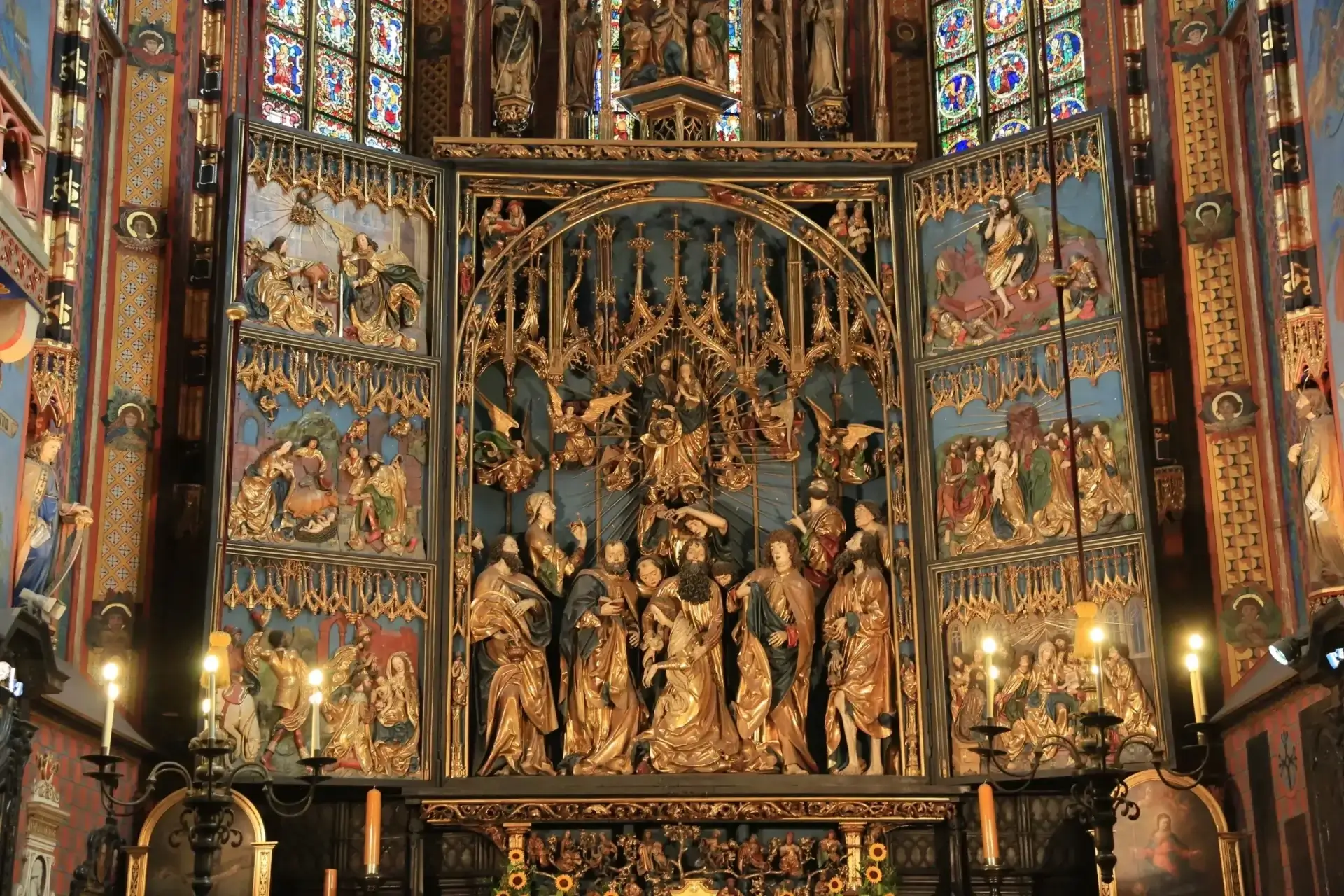
The Veit Stoss Altar – A Difficult Return and the Forgotten Soldier
(For professors, teachers, art historians, and students)
In September 1939, at the beginning of the German invasion of Poland, German Kommando Paulsen arrived in Kraków and stole the Veit Stoss altar from St. Mary’s Basilica, transporting it to Berlin and then to Nuremberg. This priceless piece of sacred art remained in Germany until the end of April 1946. Escorted by American soldiers, a special train brought the stolen work of art back from Nuremberg to Kraków on April 30, 1946.
Agata Wolska undertook the challenging task of researching this topic in her doctoral dissertation The Veit Stoss Altar – A Difficult Return at the Jagiellonian University in Kraków, Poland. Agata Wolska’s dissertation contains the following Chapters:
Chapter I. Kraków’s Greatest Loss
I.1 Protection from Destruction
I.2 The Threat of Confiscation
I.3 Cultural Restitution
I.4 Summary
Chapter II. Theatre of the Imagination
II.1 Data Collection in Poland
II.2 Activities of the Polish Government in Exile
II.3 Files
II.4 Treaty Proposals
II.5 Summary
Chapter III. Commissions and Committees
III.1 Commission at the Central Institute of Art and Design
III.2 Professor Karol Estreicher’s American Trip
III.3 Committee for the Protection and Restitution of Cultural Property – The Vaucher Committee
III.4 Files of the Vaucher Committee
III.5 Restitution Projects
III.6 Summary
Chapter IV. The Shelter Under Castle Hill
IV.1 Preparation of the Polish Expert
IV.2 Diplomatic Operations
IV.3 Nuremberg and its Repositories
IV.4 Finding the Altar
IV.5 The Nuremberg Castlings
IV.6 Summary
Chapter V. An Act of Good Will – Token Restitution
V.1 The Army Guarding the Treasures
V.2 Interim Plan
V.3 Token Restitution
V.4 Honorary Deputy of Lt. Col. Szymanowski
V.5 Summary
Chapter VI. On the Threshold of Restitution
VI.1 The Office of Restitution and Compensation
VI.2 Prof. Estreicher’s Mission
VI.3 Nuremberg Before the Trial
VI.4 Munich Central Collecting Point
VI.5 Summary
Chapter VII. The Kraków May Day and its Consequences
VII.1 Preparations in Nuremberg
VII.2 Logistics and Public Relations
VII.3 Preparations in Kraków
VII.4 A Difficult Return
VII.5 Conservation and Publicity
VII.6 Summary
Conclusion
List of Abbreviations
List of Sources and Literature
List of Illustrations
Agata Wolska’s extensive research led her to Brown University in Rhode Island and the National Archives in Washington, DC. At the National Archives, Agata discovered that Private Curtis L. Dagley, an 18-year-old soldier in Germany, was assigned to a special mission in 1946. He was one of 14 guards on a special 27-car train from Nuremberg, Germany, to Kraków, Poland, that was returning priceless artworks stolen in Poland by the Nazi Germans during the war. Included in these artworks was the renowned 15th-century Gothic altarpiece from St. Mary’s Basilica in Kraków. It was the country’s most famous and sacred work of art, a true national treasure.
Five days after the train’s arrival on April 30, 1946, Dagley was arrested at random by the Communist-controlled Polish Security Police for shooting a civilian. He was completely innocent. But he was imprisoned for four months and used as a pawn by the Polish Communist and American governments as they worked out their post-war relations. In 2012, Agata Wolska traveled to Gloucester, Massachusetts to learn from Dagley the full details of his gripping experience and to present him with a scrapbook of photos, other documents, and a gift of thanks from the parishioners of St. Mary’s Basilica.
Here is the article by David Rhinelander “Curtis Dagley’s WWII mission: Return priceless art to Poland,” that was published by the Cape Ann Beacon on 21 August 2012.
“The greatest art treasure onboard the special train from Nuremberg, Germany to Kraków, Poland that Gloucester’s Curtis Dagley and other American soldiers were guarding was the 15th-century hand-carved “Altarpiece” by the Bavarian sculptor Veit Stoss.
The largest such Gothic piece in the world, it measures 43 feet high by 36 feet wide when the two side panels are opened completely at the altar of St. Mary’s Church in Kraków. Some of the incredibly realistic figures are 12 feet high. The revered altarpiece tells the story of Mary in the expiation of sins of the world by her son Jesus Christ.
Like so many great art works, it had been hauled away by the Germans in 1939 as a war prize. Fortunately for all, President Franklin D. Roosevelt had set up a special commission in 1943 to find, protect, and return the plunder to their owners. Among the members of the commission, known as the Monuments Men, was Walker Hancock of Lanesville.
Sculptor Veit Stoss moved from Nuremberg to Kraków in 1477, when he was commissioned to produce and install his masterpiece. He returned to Germany 20 years later.
It was his German origins that made the Poles particularly anxious to hide one of their greatest treasures from the invading Germans, knowing the Third Reich would claim it as a German work of art. It was dismantled and hidden in the countryside. But the Gestapo located every crate. All were shipped off to Germany and hidden in the bowels of a castle in Nuremberg.
The Polish government-in-exile was collecting information about where the stolen art was hidden. When the advancing American Army found them safe and sound, the Monuments Men knew exactly what to do – return the sacred altarpiece to Kraków. Curtis Dagley and the other Americans arrived in Kraków in April of 1946. The triptych was restored and reassembled, but the Polish Communist government delayed its return to St. Mary’s Basilica for another decade.
Art historian and St. Mary’s archivist Agata Wolska, who spent more than a year tracking down Dagley, came to Gloucester last month to thank him. Among her sponsors were the Rev. Dr. Dariusz Ras, the parish priest of St. Mary’s, the Rev. Dr. Bronislaw Fidelus, Vicar General of the Archdiocese of Kraków, Mrs. Christine Freemantle Sapieha of London, and the Rev. Marek Stroba OMI, of Midland, Texas.
She brought with her a wooden plaque that included copper roofing from the church that was inscribed “with the compliments from St. Mary’s Parish.” She also gave him a scrapbook of photos taken surreptitiously by an American officer of the guards at the train station.
‘Oh yes, that’s me,’ Dagley said of a tall young private in uniform. Another showed him being handcuffed and led away. ‘Wow, son of gun. But at least I made it out,’ he added with a big smile.
‘Yes, I want to keep this and show this to my grandchildren. Thank you for coming,’ he added, turning to the beaming Agata Wolska at his side.”
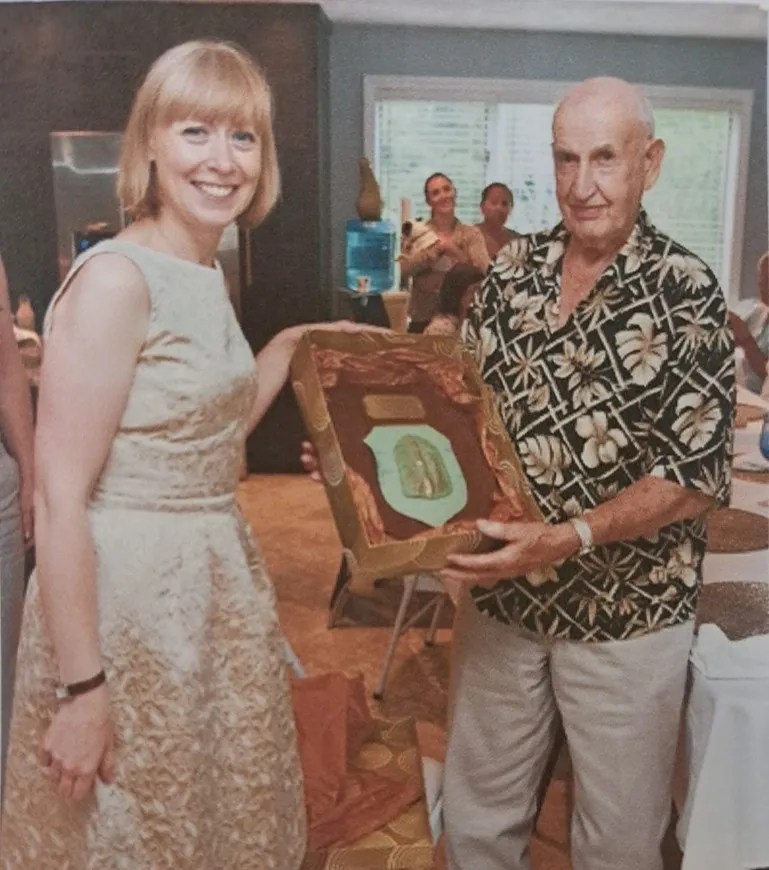
Agata Wolska and Curtis Dagley with wooden plaque and copper roofing from St. Mary’s Basilica that was a gift of thanks from the church’s parishioners.
————–
[Note: Curtis Dagley passed away on August 10, 2022. He was 94 and was survived by his loving wife Nancy of 44 years.]
