
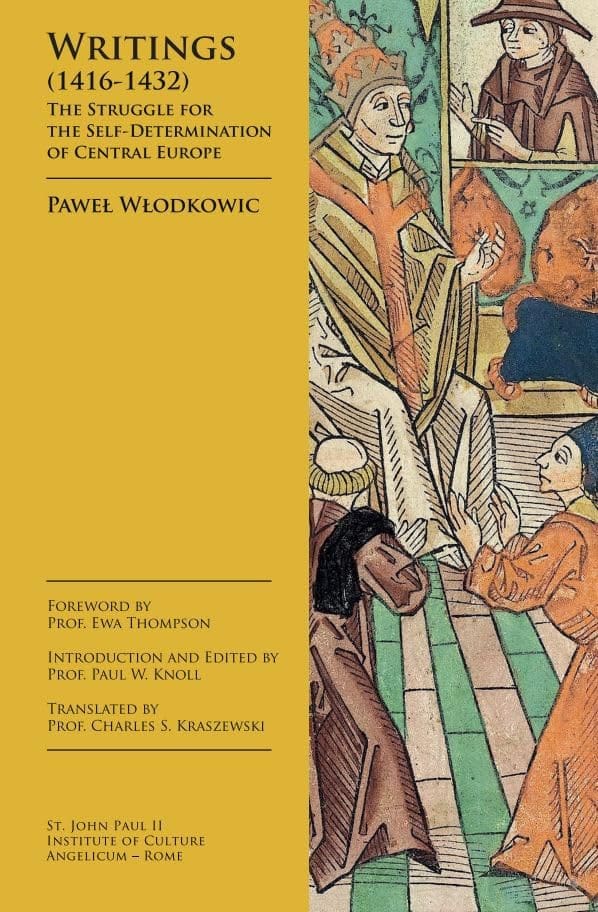
Writings (1416–1432): The Struggle for the Self-Determination of Central Europe, by Paweł Włodkovic
(For professors, students, and teachers interested in the history of Poland and international law.) The citation for this work is: Writings (1416-1432): The Struggle for the Self-Determination of Central Europe, by Paweł Włodkowic. Rome: Angelicum University Press Fundacja Świętego Mikołaja, 2023.
The Foreword of Writings is by Prof. Ewa Thompson, which provides a thorough summary of Włodkowic’s work and is presented at this link. The Introduction is by Prof. Paul W. Knoll, who also edited Włodkowic’s work, and the translation into English was skillfully done by Prof. Charles S. Kraszewski.
Viewers are strongly encouraged to read Prof. Thompson’s Foreword because, among many other key points it presents, it also outlines the relevance of Włodkowic’s work to contemporary thought on peaceful coexistence among nations and human rights.
Paweł Włodkowic was a Polish scholar, jurist, statesman, priest, and doctor of canon law at the Kraków Academy. He advocated for religious tolerance and defended Poland and the pagan Baltic tribes against the Teutonic Knights as well as the Christian crusade movement in general.
Włodkowic represented Poland at the 1414 Council of Constance, which was an ecumenical council of the Catholic Church held from 1414 to 1418 in the Bishopric of Constance (Konstanz) in present-day Germany. It was the first ecumenical council convened in the Holy Roman Empire.
At the Council, Włodkowic delivered a thesis about the power of the Pope and the Emperor, titled Tractatus de potestae papae et imperatoris respectu infidelium (Treatise on the Power of the Pope and the Emperor Respecting Infidels). In it he argued that pagan and Christian peoples could coexist in peace and he criticized the Teutonic Order for conquering and killing the native pagan peoples of Prussia and Lithuania under the pretense of converting them to Christianity.
Today, we can consider Pawel Włodkowic’s thoughts as having eventually created conditions for the emergence of the modern concept of human rights and religious tolerance.
“There must be a return to the wisdom of the old teacher Paweł Włodkowic, Rector of the Jagellonian University at Krakow in the 15th century, and the rights of nations must be ensured: their right to existence, to freedom, to independence, to their own culture, and to honorable development.” Homily of John Paul II, Auschwitz – Birkenau. 7 June 1979.
